"Quite shocking" Collapse of Atlantic current more likely than previously thought, according to study

"This is very worrying": a new study concludes that the collapse of a major Atlantic current is more likely and could occur sooner than previously thought.
No time? blue News summarizes for you
- The Atlantic Meridional Overturning Current (AMOC) could reach its tipping point in the next few decades, according to a new study.
- Even with falling emissions, a collapse of the AMOC - which also includes the Gulf Stream - may no longer be preventable.
- Climate models have recently tended to indicate that a collapse before 2100 is unlikely.
- Even with low future emissions, a collapse of the AMOC occurred in 25 percent of the models in the new study.
- If the current collapses, there is a threat of extremely cold winters in Western Europe, among other things.
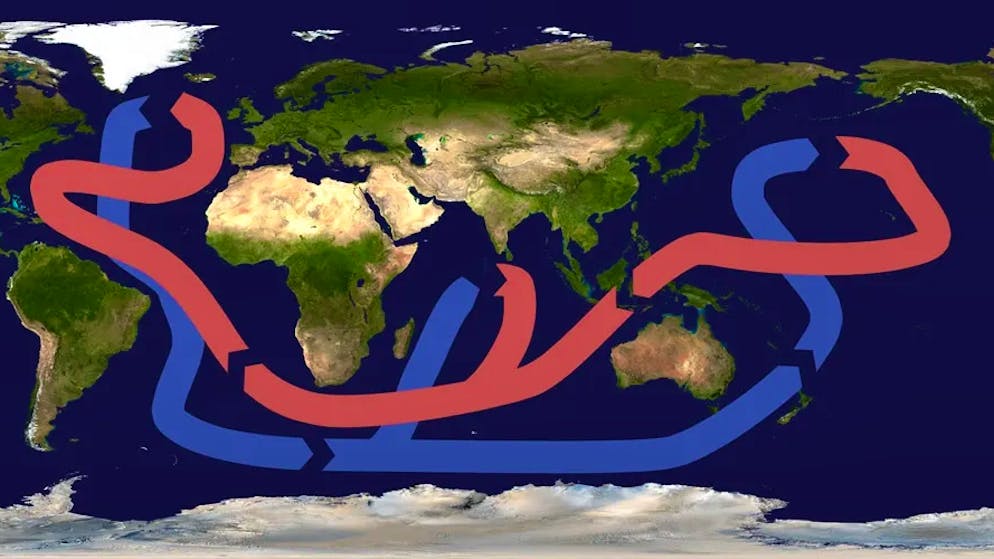
The Atlantic Meridional Overturning Current (AMOC) - which also includes the Gulf Stream - is an important component of the global climate system. It transports tropical water warmed by the sun to Europe and the Arctic, where it cools and sinks to form a deep return current.
This ocean conveyor belt contributes to Europe's relatively mild climate and influences weather patterns worldwide. It was already known that the Amoc is weaker than it has been for 1600 years due to the climate crisis.
Tipping point could be reached in the next few decades
According to a new study, the collapse of this important Atlantic current can no longer be regarded as an unlikely event. According to the study, a drastic reduction in fossil fuel emissions is becoming even more urgent in order to avoid catastrophic effects on the global climate.
"In our simulations, the tipping point in key marine areas of the North Atlantic typically occurs in the next few decades. This is very worrying," Stefan Rahmstorf, head of the Earth System Analysis research department and co-author of the study, is quoted as saying in a statement from the Potsdam Institute for Climate Impact Research.
"Most climate projections end in 2100, but some of the IPCC's standard models have now been projected centuries into the future and show very worrying results," says Sybren Drijfhout from the Royal Netherlands Meteorological Institute, lead author of the study published in Environmental Research Letters.
Climate models recently tended to indicate that a collapse before 2100 was unlikely. However, the new analysis also examined models that ran over a longer period up to 2300 and 2500. They show that the tipping point that makes failure of the AMOC inevitable is likely to be passed within a few decades, but that the collapse itself may not occur until 50 to 100 years later.
"Quite shocking"
The study also found that as carbon emissions continued to rise, 70 percent of model runs led to collapse, while at intermediate emission levels, collapse occurred in 37 percent of models. Even at low future emissions, 25 percent of the models experienced a breakdown in AMOC.
The new results are "quite shocking, because I have always said that the probability of AMOC collapse due to global warming is less than 10 percent," Stefan Rahmstorf told the British daily newspaper The Guardian."Even in a low-emissions scenario that adheres to the Paris Agreement, the probability now seems more like 25 percent."
Extremely cold winters looming in Western Europe
These figures are "not very certain", but "we are talking about a risk assessment where even a 10 percent probability of an AMOC collapse would be far too high", explains the ocean physicist.
Researchers first discovered warning signs of a tipping point in 2021. It is also known that the AMOC has already collapsed in the Earth's past.
It would shift the tropical rainfall belt that millions of people rely on to grow their food, plunge Western Europe into extremely cold winters and summer droughts and raise the already rising sea level by another 50 centimetres.
In recent years, scientists have repeatedly warned that a collapse of the AMOC must be avoided "at all costs".