From Switzerland to Lesotho Trump is imposing tariffs on the entire world - the most important points
US President Trump is relying on drastic punitive levies for trading partners and is unyielding. He justifies his plans with unfair trade practices. The new package has it all.

03.04.2025, 06:16
03.04.2025, 11:54
SDA
No time? blue News summarizes for you
- The US President has issued a decree imposing tariffs on "the whole world".
- On Wednesday, Trump presented his plans in the White House Rose Garden, including the consequences for Switzerland.
- The measures are not only complex, but also unprecedented in their scope.
- We list questions and answers about the package.
For weeks, US President Donald Trump had been threatening a comprehensive XXL customs package. The uncertainty caused concern worldwide. Now Trump has also presented his plans with consequences for Switzerland. They are not only complex, but also unprecedented in their scope. Questions and answers about the package:
What has Trump announced?
From Saturday, the USA will impose a blanket tariff of ten percent on imports from all countries. In addition, the US government announced a complex mechanism that provides for higher tariffs for many countries. This will apply from April 9. One of Trump's advisors described these countries as the "worst offenders". This refers to countries with which the US government believes the United States has a particularly large trade deficit.
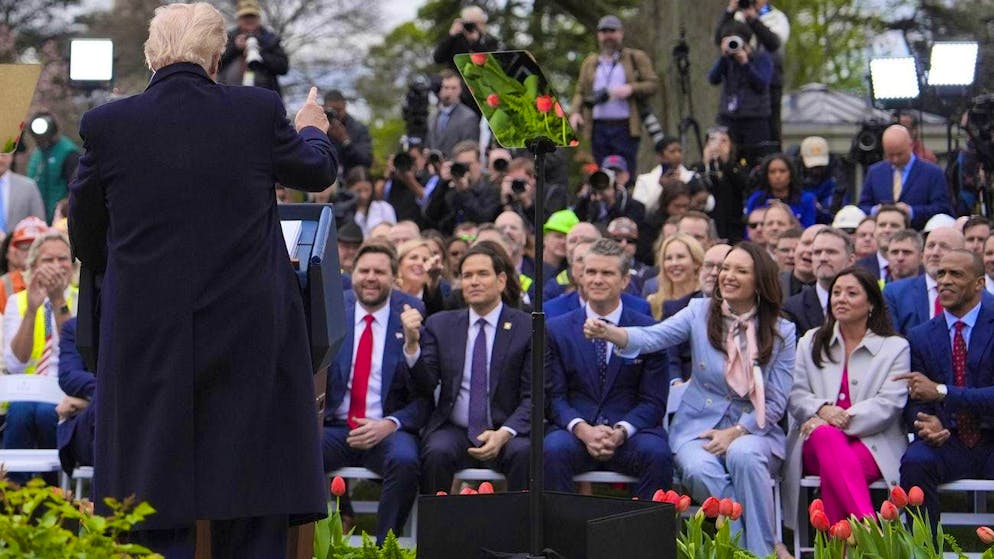
At this point, the US is talking about imposing reciprocal tariffs - in other words, a principle of reciprocity. Their argument: many countries make it more difficult to import US products, and this can no longer be tolerated. "The idea is that we treat other countries the way they treat us," said one of Trump's advisors.
Washington is not only referring to tariffs, but also trade barriers such as subsidies, strict import regulations, theft of intellectual property and currency manipulation in its calculations. These barriers are "far worse" than the actual tariffs, according to the White House.
The US government has now calculated a percentage for each country that reflects both tariffs and these other trade barriers. The corresponding tariff on imports from these countries is then derived from this. In each case, it is about half as high as the value determined by the USA, which is difficult to verify. Why only half? Trump justifies this with his leniency and says: "We are good people."
What does this mean for Switzerland?
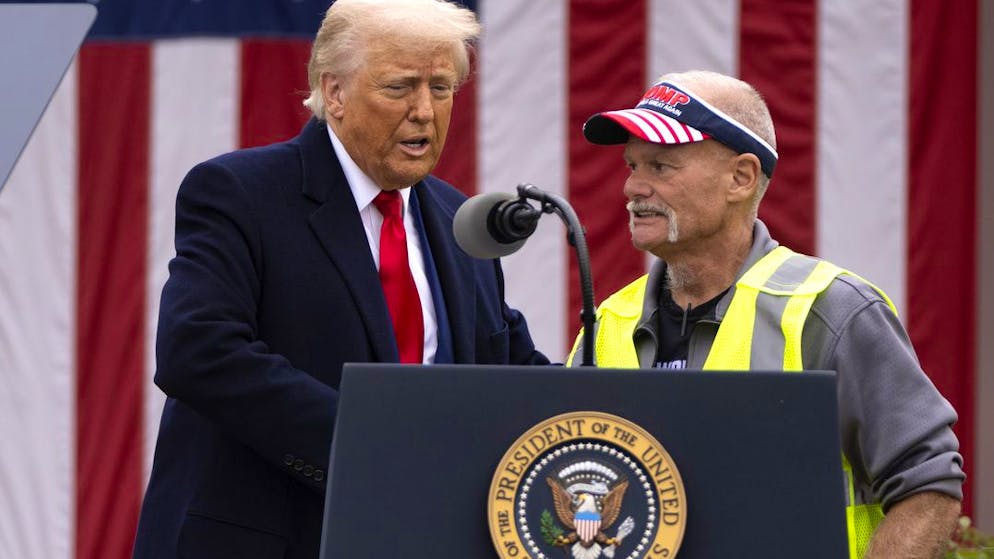
Trump announced tariffs of 31 percent on Swiss exports. The tariffs are a reaction to the 61 percent tariffs that Switzerland imposes on US products, Trump said. According to the Swiss business umbrella organization Economiesuisse, there are no comprehensible reasons for the tariffs from an economic perspective. "Overall, Switzerland's import tariffs are already significantly lower than those of the USA," the association said in its statement. According to Economiesuisse, the new US tariffs would not only make Swiss exports more expensive, but would also weaken the competitiveness of companies and have a negative impact on the investment climate.
What is Switzerland's initial reaction?
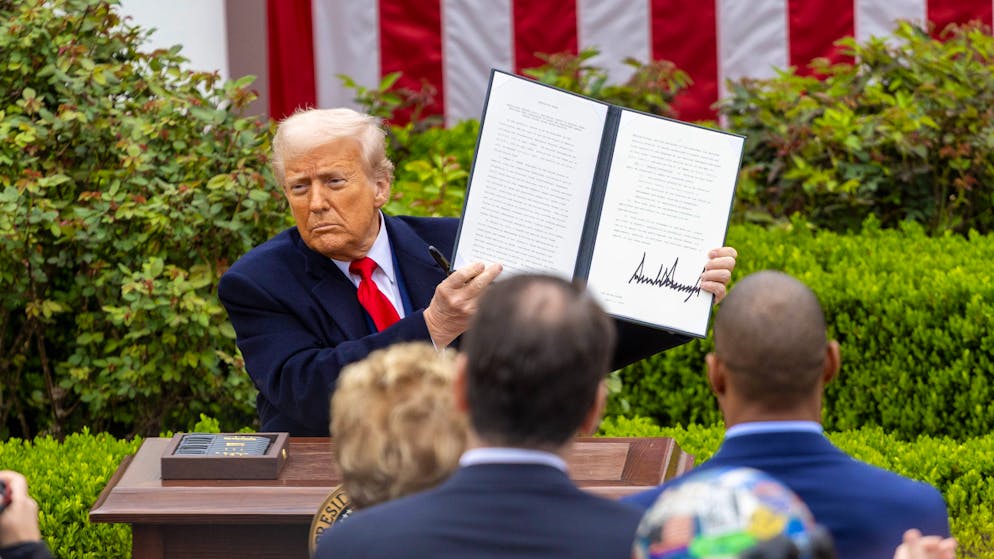
It was initially unclear how Switzerland would react to the announced tariffs. The Federal Council "takes note" of the US decisions, wrote President Karin Keller-Sutter in an initial reaction on X on Wednesday evening. The Federal Council will quickly determine the next steps.
The Federal Council had already held a closed meeting on the topic of "USA and Switzerland" on Wednesday. The Federal Council spokesperson ad interim Ursula Eggenberger did not provide any details afterwards. In general, Eggenberger said that the Federal Council had repeatedly discussed the potential impact of US measures on Switzerland. "The Federal Council will be informed on Thursday about the decisions from the USA and their consequences for Switzerland," Eggenberger stated. It remains to be seen whether this will be communicated in the media afterwards.
What does this mean for the European Union?
For the European Union (EU), this means that exports from its member states to the United States will be subject to a 20 percent tariff from next week. As the world's third-largest economy, Germany is not listed individually in the White House's tariff list, but is covered by the provisions for the EU. Trump not only criticizes the EU for higher tariffs, he also criticizes the VAT levied in Europe as a significant trade barrier for US products. However, this argument is questionable, as VAT is equally applicable to products from the EU.
The Americans have calculated that the EU imposes tariffs of 39% on US imports - taking into account all trade barriers. It is unclear exactly how the US government has calculated this figure. The EU itself states that it is difficult to determine an absolute value for technical reasons, as an average can be calculated in very different ways. "However, based on actual trade in goods between the EU and the US, the average tariff rate in practice is around one percent on both sides," the EU Commission emphasizes.
Experts consider the tariff differences with the European Union to be rather small in most areas. The major exception is the agricultural sector, where EU tariffs are in some cases significantly higher than in the USA - particularly on dairy products, meat, sugar and poultry. Different standards and import requirements also need to be taken into account here. Textiles and clothing from the USA are also usually subject to slightly higher tariffs in Europe than vice versa - although the difference is sometimes minor. Conversely, customs duties on plastics, chemicals, works of art and antiques are sometimes higher in the USA than in the European Union.
Which countries are subject to particularly high tariffs?
Some countries will be hit particularly hard by the new tariffs. In some cases, very small trading partners are being heavily penalized, such as crisis countries like Syria and Myanmar. The most severe punitive tariffs of 50 percent each apply to the small African state of Lesotho and a French overseas territory, the archipelago of Saint-Pierre and Miquelon. They are followed by Cambodia with 49 percent and Laos with 48 percent, ahead of Madagascar with 47 percent. Vietnam has to cope with 46%, for Myanmar and Sri Lanka it is 44% and Syria 41%.
For China, the world's second-largest economy after the USA, the new tariffs amount to 34% - in addition to the steep penalties already in force on products from the People's Republic.
What happens now?
President Trump has declared a national emergency. The US government cites economic and security policy risks in view of trade deficits with other countries as the reason.
"This is not a negotiation, this is a national emergency," a Trump advisor replied when asked whether the countries affected could still prevent or mitigate the tariffs. He made it clear that other countries could not simply announce lower tariffs on US imports in order to obtain tariff relief from the USA. He cited the other trade barriers that would put the USA at a disadvantage.
According to the White House: "The tariffs will remain in effect until President Trump determines that the threat posed by the trade deficit and the underlying disparate treatment has been eliminated, resolved, or mitigated."
Are there special rules?
Even before Trump's huge tariff announcement, the USA had already imposed various punitive levies on certain products, which continue to apply. From today, tariffs of 25 percent are to apply to all cars imported into the USA, and this punitive measure is to take effect for car parts by May 3 at the latest. The USA is also imposing tariffs of 25 percent on all steel and aluminum imports. Certain imports from Canada and Mexico will also be subject to punitive duties - but there are certain exceptions. None of these specific tariffs are likely to change for the time being - according to the information provided, the new customs regulations will not apply here.
What can the pharmaceutical industry expect?
A high-ranking government representative made it clear that Trump could soon impose even more specific punitive measures on certain product groups - regardless of which country they come from. He explicitly mentioned semiconductors, critical minerals and pharmaceuticals. The latter group is likely to interest the Swiss pharmaceutical industry. The pharmaceutical industry was initially exempt from trade tariffs, but Trump confirmed last week that he would soon impose tariffs on the sector too.
Swiss companies that do not have their own production facilities in the USA and are therefore particularly vulnerable to tariffs had already expressed concerns before the latest announcement. Generics manufacturer Sandoz, for example, fears negative effects: Unlike the two Basel-based pharmaceutical giants Roche and Novartis, it does not have a production facility in the USA. Should additional costs arise, Sandoz, like other companies, plans to pass these on to US consumers. Meanwhile, moving production to the USA, as Trump would like, is out of the question for the Sandoz CEO.