Music With harp and attitude: Julie Campiche's tribute to women
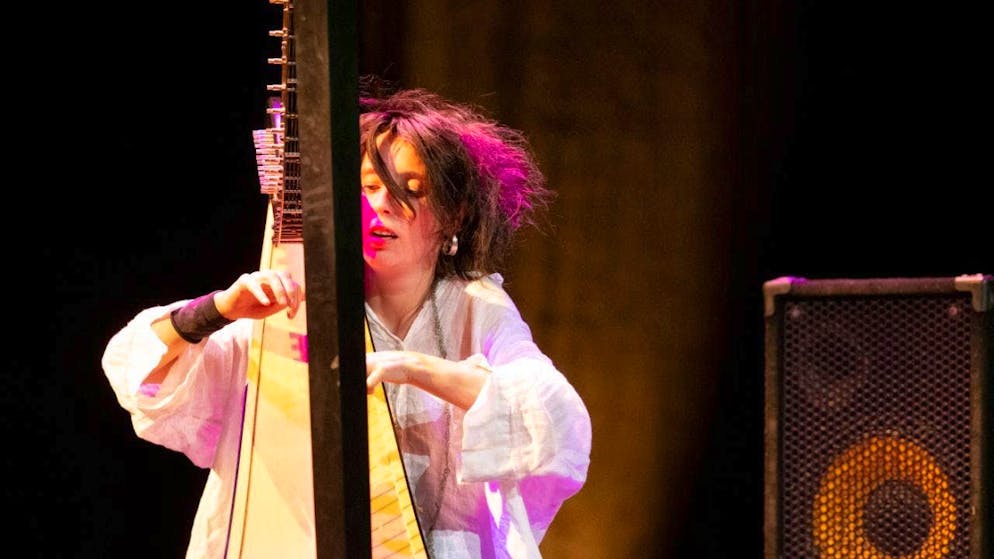
At an intimate concert evening in Bern, Geneva harpist Julie Campiche focuses on women whose stories often go unheard. Her solo debut "Unspoken" combines harp, electronics and spoken word to pay homage to the invisible.

24.02.2026, 06:45
24.02.2026, 06:46
SDA
It's a Sunday evening in Bern, Julie Campiche is sitting at her harp in the gym of the Progr cultural center and doing the sound check. On this evening at the concert promoter Bee-flat, she is launching her first solo album "Unspoken", which was released in mid-February.
The musician from Geneva has long since made a name for herself in French-speaking Switzerland. Last September, the harpist was even awarded the Swiss Music Prize. Having previously toured in various formations, including with her Julie Campiche Quartet, the 43-year-old is now on her first solo tour, which will take her through Switzerland and abroad.
Motherhood leads to first solo album
The birth of her first daughter prompted her to embark on a solo album, says Julie Campiche in an interview with the Keystone-SDA news agency before the concert. In the meantime, her second child has also been born. Her 19-month-old daughter sits on her mother's lap. She recalls: "Being a mother has shown me how unequal women and men still are in our society." The "mental load" alone is enormous.
During the Covid-19 pandemic, she was forced to play music solo. "It gave me back a feeling that I hadn't had for a long time." Campiche decided to create her first solo album. "I wanted the challenge to give me new self-esteem, and that's what I got."
The result is the atmospheric album "Unspoken", which is characterized by both quiet and darkly epic moments. It is a tribute to women who achieve or have achieved great things, but who have mostly been forgotten. In addition to the intro and outro, six tracks are each dedicated to one such personality. "These are very subjectively selected women whose stories touched me," says Campiche.
Jazz, salsa and noise collages
She works with electronic effects, her voice, spoken word elements, sound recordings and, of course, the harp - the instrument that is clearly dominated by women in this country. "Not so in South America," Campiche points out. "It's mainly men who play the harp there."
Speaking of South America: if you listen to the record, you can make out rhythms and melodies from Latin American music in many places. The jazz musician, who originally trained in classical music, was also guided by her passion for salsa.
This can be heard clearly in the piece "Grisélidis Réal". On the one hand, Campiche creates a bit of a summer atmosphere with the harp, while on the other, she uses electronic effects to tell the story of the Swiss sex worker Grisélidis Réal (1929-2005), who campaigned for women's rights in the sex trade. The piece has something of a sound collage: you can hear moaning, children laughing or a pen moving across paper - because Réal was not only a sex worker but also a mother, painter and author.
Polyphonic spoken word music
It's not a crowd, but rather a few dozen people who have made their way to Bern for the musician's album launch. There is a club atmosphere, which is fitting when Julie Campiche begins with the intro "Anonymous" and text fragments are projected onto the stage. Campiche's music is accompanied live by harmonious visual effects.
The sentence "For most of history, Anonymous was a woman" can be heard in several languages. This is a paraphrase of Virginia Woolf, the sentence refers to how women were long forbidden to appear in public and thus had to hide behind anonymity. The women's voices, which Campiche came across via a social media appeal, overlap in the piece so that "Anonymous" becomes a kind of polyphonic spoken word music. Campiche uses the harp to create an enigmatic atmosphere.
Intimate and haunting
Between songs, Julie Campiche addresses her audience, explaining what touches her about the respective woman, whom she then portrays with harp and electronic effects. For example in the piece "Rosa", which is reduced to harp and voice and almost invites the listener into a trance with its repetitive patterns. Towards the end, a heavy, dark tapestry of sound is created with electronic support.
"Rosa" is a tribute to women who do the work in the shadows that our Western society needs but at the same time does not appreciate. In the conversation before the concert, Campiche cites care work by women without residence status as an example.
"Las Patronas", Campiche explains on stage between two pieces, are a group of Mexican women who prepare food and water for Central American migrants and distribute it to passing freight trains to support their dangerous journey to the USA. Campiche then performs the piece of the same name entirely without a harp, instead singing in Spanish, creating the humming foundation with an Indian shruti, to which she beats a drum in ritual time.
Campiche ends the intimate, one-and-a-half-hour concert after an encore, she says thank you, but now it's really over, she says, laughing: "My head is broken!" Afterwards, she stands behind her merch stand and talks to a concertgoer.
The first solo tour has begun and will take Julie Campiche to stages large and small. Then in mid-March in Berlin, where she will play together with the Deutsches Symphonie-Orchester.
https://www.bee-flat.ch/programm/archiv/meet-greet-artist-talk-mit-julie-campiche-julie-campiche-solo-5074/