International Hope grows in Gaza after UN Security Council vote
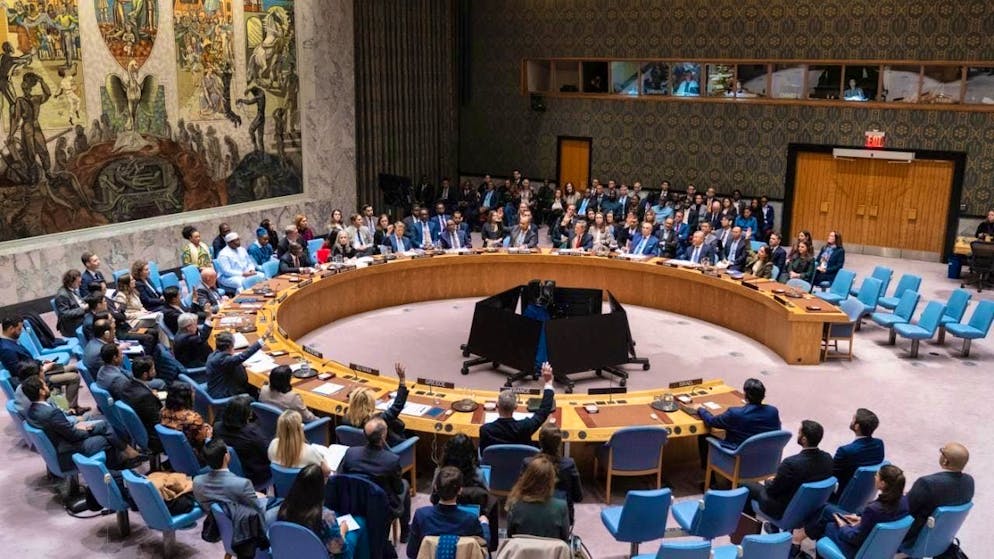
Hopes for a lasting ceasefire are growing in the Gaza Strip: the UN Security Council, which has been at loggerheads for years, has passed a resolution to safeguard US President Donald Trump's peace plan.

18.11.2025, 05:48
SDA
With its approval, the highest body of the United Nations sent a clear signal that the peace plan can count on broad support from the international community. Trump classified the adoption as historic progress. The Islamist Palestinian organization Hamas, on the other hand, rejected the resolution. There had already been critical voices in Israel before the resolution was passed.
Of the 15 member states, 13 voted in favor of the resolution introduced by the USA on Monday (local time) in New York. Russia and China, which normally make use of their right of veto on many conflict issues, abstained.
The adoption of the paper represents a legally binding mandate and is seen as a breakthrough for the Security Council, which has long held opposing positions on the approach to the Middle East conflict between Israel and the Palestinians. For the US government, the approval of the resolution is a diplomatic success.
Trump and Guterres praise resolution
Trump wrote on his online mouthpiece Truth Social: "This will go down as one of the greatest endorsements in United Nations history, will lead to further peace around the world, and is a moment of truly historic proportions!" The vote signifies the "recognition and endorsement of the PEACE COUNCIL, which is chaired by me".
The establishment of the peace council is one of 20 points in the Gaza peace plan that Trump presented at the end of September. It envisages that the Gaza Strip will initially be administered by a committee of non-political experts as a transitional government. This committee is to be made up of qualified Palestinians and international experts and will be supervised and monitored by a new international transitional body - the "Board of Peace", which Trump intends to chair.
UN Secretary-General António Guterres described the adoption of the resolution as an "important step towards consolidating the ceasefire", which must now be followed by others. "It is essential that this diplomatic momentum is now translated into concrete and urgently needed steps on the ground."
Critical voices from Israel - rejection of Hamas
In Israel, criticism of the text of the resolution had already been voiced prior to its adoption because it refers to "a credible path to Palestinian self-determination and statehood". Following the vote in the Security Council, there was initially no reaction from the Israeli government.
Hamas, on the other hand, immediately rejected the paper. "This resolution does not meet the political and humanitarian demands and rights of our Palestinian people," the terrorist organization wrote on the Telegram platform. The resolution aims to impose an international trusteeship over the territory, which the Palestinians reject.
In addition to the disarmament of Hamas, the peace plan published by Trump at the end of September includes a force of international soldiers for stabilization and a transitional government made up of non-political Palestinian experts. However, not all of the contents are uncontroversial - in particular the disarmament of Hamas, the complete withdrawal of Israel's army from the Gaza Strip and the future administration of the area are highly controversial.
Hamas continued in its statement: "Assigning tasks and roles to the international force inside the Gaza Strip, including the disarmament of the resistance, robs it of its neutrality and makes it a party to the conflict in favor of the occupation." By "occupation", Hamas means the Israeli armed forces. The statement goes on to say: "Resistance to the occupation by all means is a legitimate right."
Autonomous Authority opposes Hamas
The Palestinian Authority (PA), which rivals Hamas and is led by 90-year-old President Mahmoud Abbas and administers parts of the West Bank, is calling for the resolution to be implemented immediately. According to a report by the Palestinian news agency Wafa, the PA said it was "urgently necessary to implement this resolution on the ground without delay". The path to peace between Palestinians and Israelis must be advanced and be based on the two-state solution - in other words, on a future in which an independent state of Palestine exists peacefully side by side with Israel.
Hamas, on the other hand, strictly rejects the two-state solution sought by the international community for the region. It is committed to the destruction of Israel and wants to establish an Islamic state on the entire territory of historic Palestine.
Israel's right-wing conservative government rejects a two-state solution on the grounds that a Palestinian state would jeopardize the existence of the Jewish state. However, the Israeli leadership is also opposed to PA rule in the Gaza Strip - and accuses the authority of promoting terrorism. Compared to the Islamist Hamas, Abbas and the Fatah movement, which he also leads, are considered to be much more moderate. Abbas wants to be involved in the future government in the Gaza Strip.
Resolution as a "lifeline" - but also criticism
The USA had campaigned vehemently for the adoption of its resolution, but its success ultimately came as a surprise to many. The paper was a "lifeline" for the region and further delays would only cost lives, said US Ambassador Mike Waltz at the Security Council meeting.
Before the vote, it had long looked as if the resolution might fail. Russia and China had signaled their dissatisfaction; the Russian government even submitted its own draft resolution, which was not put to a vote. Following their abstentions, both countries criticized, among other things, that the resolution contained too few details and gave the USA too much power.