Flamingo cruise missile Kiev's wonder weapon was slowed down for a long time - but now it's really hitting its stride
The missile was loudly announced, then it quickly became quiet around the Ukrainian cruise missile. But now Volodymyr Zelensky explains what has slowed down the rise of the Flamingos- and his army is now putting its words into action.
No time? blue News summarizes for you
- According to its own announcements, Ukraine was supposed to be producing 210 Flamingos per month by now, but recently things had gone quiet around the cruise missile.
- Now Volodymyr Zelensky admits to technical problems - and explains why production has been paralyzed.
- In January, Kiev used the Flamingo again for the first time in a long time - and followed it up several times in February.
- The most recent attack targeted one of Russia's oldest engineering factories, located 1400 kilometers from the border.
What became public in August 2025 sounded so promising for Ukraine: the domestic company Fire Point is building its own cruise missile, which should be able to carry a ton of explosives up to 3,000 kilometers.
However, the FP-5 Flamingo does not take off as expected. There are a few missions in the fall, but they can be counted on one hand. At the beginning of December, the explanation is that there are technical problems: The projectile, which travels at around 900 km/h, could not yet fly as low as desired because exact altitude maps of Russia were missing.
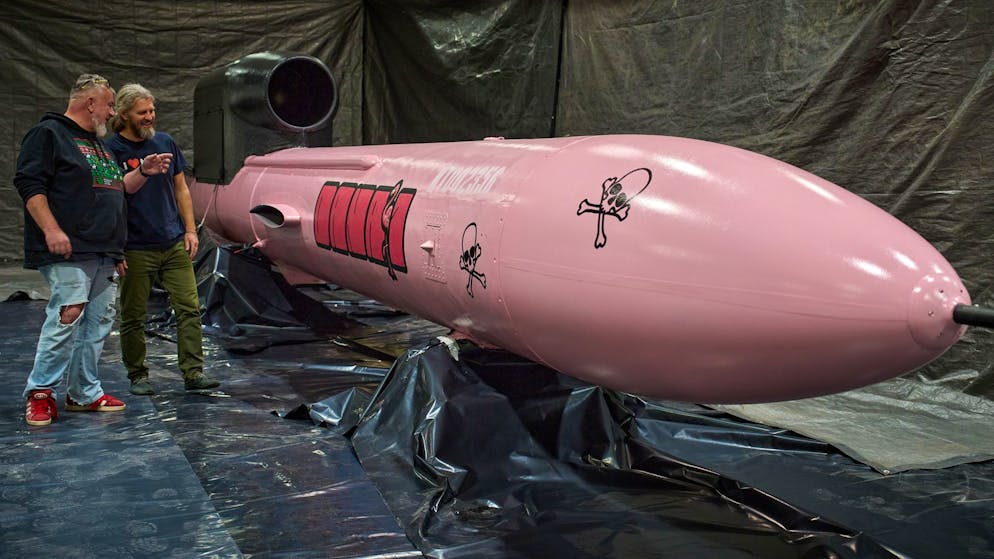
But this does not appear to be the only hurdle. The plan was to produce 210 units per month. However, Kiev is a long way from seven Flamingo attacks a day: so is the supposed miracle weapon just a flop?
Hot engine attracts Russian interceptor missiles
Volodymyr Selensky knows the answers - and admits there are problems. At Christmas, he talks about the hit rate of the Ukrainian R-360 Neptune cruise missile, which has risen from "good" to "very good". "The percentage of the Flamingo has now improved," he says.
However, this is apparently at a relatively low level: "It was recently used," the president added according to Interfax. Five Flamingos were fired: "One destroyed the target, four were shot down by Russian air defenses."
In other words, if these missiles are not flying extra low, they are apparently easy prey for the Russian military thanks to their hot engine. And in mid-February, the 48-year-old reveals the secret of why so few Flamingo attacks have been flown so far: Moscow had apparently successfully attacked the manufacturer Fire Point.
That's why Flamingo production came to a standstill
"We had some technical problems because a large production line was destroyed by a missile strike," Selenskyj quotes the Ukrainian news agency UNN. Apparently, Fire Point was too careless when presenting the Flamingo. "[The line] has already been relocated and production has resumed."
And indeed, the Flamingos are flying again. As it only became known at the beginning of February, Kiev's forces attacked the Kapustin Yar missile test site in the Astrakhan oblast on the Caspian Sea in January. The Kremlin also launches medium-range Oreshnik missiles from there.
According to the Ukrainian armed forces, the Flamingos hit a warehouse for materials, a production hall for missiles and a technical building. There is no confirmation of this damage or even confirmation of the attack from the Russian side.
Huge Russian weapons depot targeted
These attacks continued in February. On the 12th, a huge weapons depot operated by the Russian Main Missile and Artillery Directorate (GRAU) near the village of Kotluban in Volograd Oblast was targeted. The depot is only 120 kilometers away from the Kapustin Yar test site.
According to Ukrainian reports, a 3600 square meter bunker was hit, in which 20,000 to 40,000 artillery shells could have been stored, depending on the caliber. It is unclear how many rockets were used. A video shows subsequent explosions.
Volodymyr Zelensky said shortly afterwards, according to UNN: "We don't have many[Flamingos]. We deployed them a few days ago in the area where the Oreshnik systems are located. We will see the results, but I think we have achieved results. Of course, it's important that we work on increasing the number [of flamingos]."
Hit in the traditional Russian company
There are two other Ukrainian attacks in which the cruise missile may have been used: Firstly, in an attack on Volna, a port city in Krasnodar oblast opposite Crimea, from where oil is exported.
Although the use of the Flamingo is not officially acknowledged, YouTuber Suchomimus notes the unusually large crater that satellite images show. This matches the 1150-kilogram warhead of the missile. However, it is possible that the oil tanks nearby were intended to be hit: Oil from vegetables had been processed in the destroyed building.
The most recent Flamingo strike is also the longest to date: on February 20, several cruise missiles flew a good 1400 kilometers to hit the Votkinsk machine-building plant in the Republic of Udmurtia. Founded in 1759, the company is one of the oldest engineering firms in Russia.
The factory produces Iskander, Topol-M and Oreshnik missiles. At least one hall was completely burnt out after the Flamingo crashed through the ceiling into the building. As each hall apparently covers part of the production process, production is likely to have been halted for the time being.