Russia Orban: No US punishment for Russian oil imports to Hungary
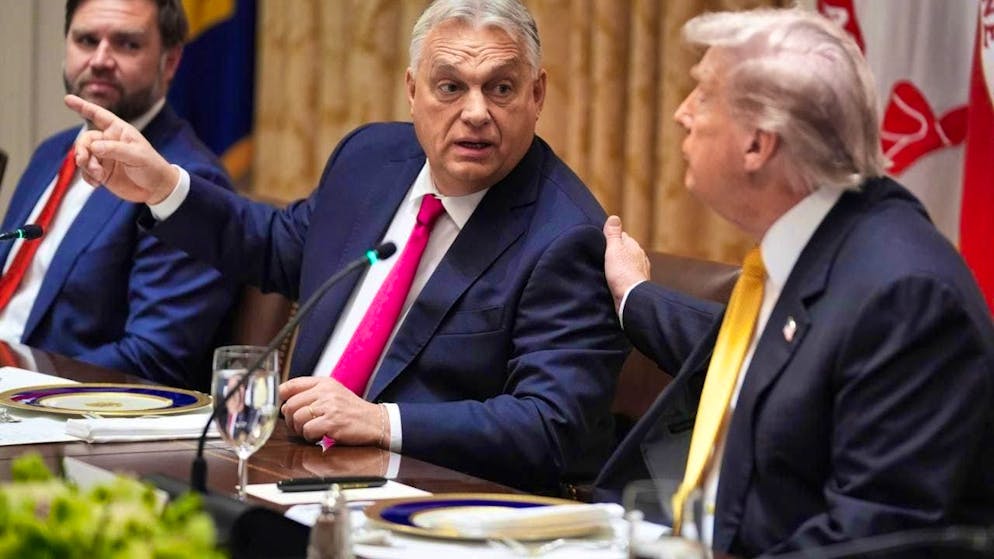
Hungary's Prime Minister Viktor Orban says he has received assurances from US President Donald Trump that his country can continue to purchase crude oil from Russia despite US sanctions against Russian oil companies.

07.11.2025, 23:43
SDA
"With regard to the Turkish Stream (natural gas) pipeline and the Druzhba (oil) pipeline, Hungary will be fully exempted from sanctions," the state news agency MTI quoted him as saying immediately after his meeting with Trump at the White House. There was initially no confirmation or reaction from the USA.
In the public part of the meeting, Trump had already shown himself open to a possible exemption for Orban. In the White House, the Hungarian had asked the US government to continue importing oil and gas from Russia because there were no short-term alternatives. Trump said that the request was being "looked into" because Hungary, as a landlocked country, has no access to seaports.
EU plan envisages renouncing Russian imports
The US government only imposed new sanctions against Russian energy companies in October, which could also result in secondary punitive measures against buyers. On Thursday, Republican and Democratic US senators jointly introduced a resolution calling on Hungary to reduce its dependence on Russian energy and adhere to the EU's plan to completely eliminate Russian imports by the end of 2027.
Hungary obtains the majority of its oil via the "Druzhba" pipeline via Ukraine. Although there is a second pipeline via Croatia, Orban argued that this can currently only be used as a supplement. He described security of supply as "vital" and warned of the consequences for the economy and households if Russian oil were to be cut off in the short term.
Trump now sees other EU states in particular as having a duty
Trump then struck a much more conciliatory tone than before. While he criticized other unnamed European states for continuing to buy Russian energy on a large scale, he presented Hungary as a special case. The landlocked country had difficult conditions without access to ports through which ships could deliver oil from other regions and was therefore "in a different position".
Selenskyj backed the end of the oil trade
Despite Hungary's insistence on importing oil from Russia, Ukrainian President Volodymyr Zelenskyi is counting on an end to this practice in Europe. Zelenskyi expressed confidence that a way out would be found "so that there is no Russian oil in Europe", as he wrote on the Telegram platform. Ukraine would not let the Russians sell oil there. Relations between Kiev and Budapest are tense due to Hungary's energy trade with Moscow.
Ukraine has already attacked the "Druzhba" pipeline on Russian territory several times. In August, for example, the flow of oil to Hungary was interrupted following a Ukrainian drone attack. At the time, Hungarian Foreign Minister Peter Szijjarto spoke of another attack on his country's energy security.
Criticism of Hungary from EU partners
Orban had traveled to the meeting with a large delegation of ministers, entrepreneurs and political allies. Many EU partners see Hungary's stance as a weakening of the common front against Moscow and accuse Budapest of having made little effort to find oil alternatives. Orban has repeatedly threatened to veto EU sanctions packages. For Orban, Trump's support is therefore also symbolically important - just a few months before the Hungarian parliamentary elections, which are considered to be the most difficult in years.
Why Orban wants Russia's oil
The fact that Hungary is heavily dependent on Russian oil and gas also has to do with the fact that Orban - unlike other EU countries such as Germany or Bulgaria - has never made any serious efforts to free his country from this dependency. In the EU, the Hungarian obtained an exemption that allows Russian oil imports via pipelines - Hungary has been connected to Russia via such a pipeline since communist times. Brussels is planning to abolish this exemption from 2027.
Trump again brings Budapest into play for Putin meeting
During the meeting with Orban, Trump also commented on the personal talks with Kremlin leader Vladimir Putin about ending the war in Ukraine, which have not yet taken place. The US president is sticking to the Hungarian capital Budapest as the venue for the possible talks. "If it (the meeting) takes place, I would like to hold it in Budapest," said the Republican in response to a question from journalists. He did not give a specific reason why this city was chosen.
Whether the meeting will take place is unclear
Whether a meeting will take place is completely unclear. In mid-October, Trump had spoken of a meeting in Budapest within two weeks. However, in subsequent contacts with Moscow, the Americans probably came to the conclusion that the Russians would not budge from their maximum demands against Ukraine. Trump postponed the meeting indefinitely. The US government also imposed sanctions against two Russian oil companies for the first time. The energy trade is an important source of income for Moscow to finance the war. This has been going on for more than three and a half years. The USA sees itself as a mediator in the conflict.
Several days ago, Russia also publicly backed away from a quick meeting with the US President. A quickly organized summit is not necessary at the moment, Kremlin spokesman Dmitry Peskov told the state news agency Tass in Moscow.
In the summer, Trump received Putin in the US state of Alaska for a two-way meeting. There were no concrete results after that.