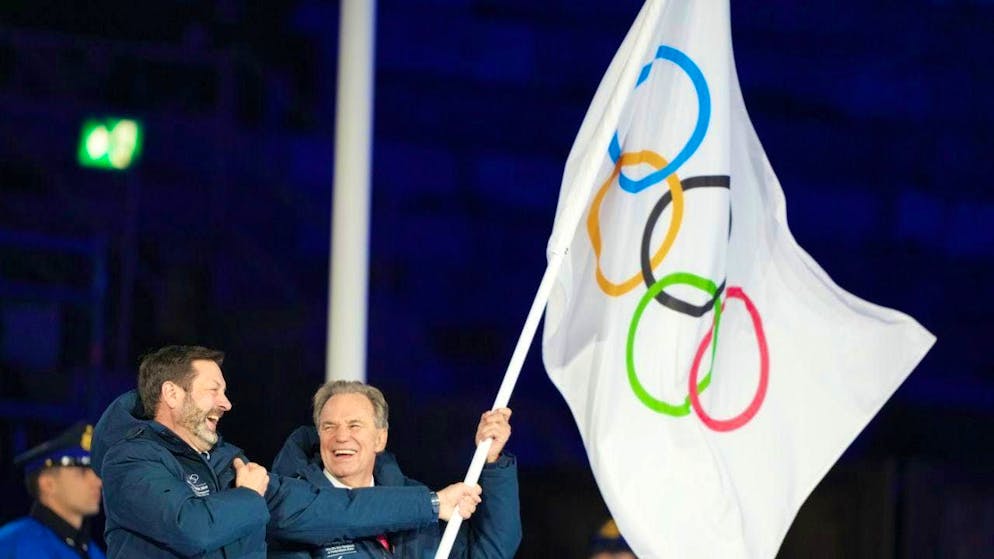
The Games in Milan-Cortina are history - in the truest sense of the word. It was the Olympics as it once was and as it should be. France 2030 and perhaps Switzerland 2038 can learn from it.

24.02.2026, 05:01
24.02.2026, 06:41
SDA
"Grazie mille Italy" - the words of Swiss delegation leader Ralph Stöckli at the end of the Winter Olympics in northern Italy are well deserved. Milan-Cortina had the courage to put an end to the much-criticized Olympic gigantism and rely on existing, decentralized venues. It is the path that the IOC wants and needs to take if it wants to make the Olympic Games possible in the core regions of winter sports.
It is a tradition for the IOC President to praise the organizer at the end. But Kirsty Coventry is not exaggerating when she says: "You have established a new generation of Olympic Games and you have created a model for the upcoming Games." The fact that the Italians' decentralized concept has worked is also important for Switzerland. The plans for hosting the 2038 Games envisage the same concept.
Italianità with Ricchi e Poveri
"It was courageous how the Italians rose to the challenge," says Stöckli. And on the whole, the risk paid off. Many things worked extremely well. The games exuded a distinct Italianità, that incomparable blend of joie de vivre and elegance.
"Sarà perché ti amo" by the 80s cult band Ricchi e Poveri became the catchy tune of Milan-Cortina. And that fits perfectly, because in Cortina d'Ampezzo, once an Olympic venue in 1956, it was also a journey into the past. The Olympics in the mountains, with lots of snow, chalet charm and the unique backdrop of the Dolomites. Nostalgics were reminded of Lillehammer 1994, the last time the Olympic Games were held in a truly traditional winter setting.
Lack of contact with other sports
Not everything was perfect, of course, and future organizers will have to learn from this. The biggest criticism from the athletes is the lack of Olympic spirit when the different sports have different venues. There were hardly any complaints in this regard from Cortina and Milan, where there were larger Olympic villages, with the Alpine skiers from Bormio being the loudest. This is perhaps because they are used to different crowds from the January races in Adelboden or Schladming and therefore also missed the atmosphere from the fans. Others, such as the freestylers, were happier to see more spectators than usual.
"But in the end, it's the competition venues that count for the athletes," emphasizes Stöckli - and thanks to the central concept, they were top-notch. There were largely no surprise winners, which is also a sign of fair conditions. In the end, the athletes' wishes are often somewhat contradictory. They want more Olympic togetherness, but then stay in hotels on the cross-country ski trail or ski slope, even if there is an Olympic village a few kilometers away.
Desire for proper medal celebrations
However, one point that can be implemented and should definitely be changed is the medal ceremonies. The lack of a ceremony on a "Medal Plaza" in the respective village center was criticized across the board, the medal handover in the finish area of the competition venues was described as undignified and lacking in atmosphere. "That is certainly a lesson," says Stöckli.
That leaves the question of the spectators. 1.3 million tickets were sold, which corresponds to 88% of the maximum capacity. 37 percent of visitors were Italian, followed by Germans (15 percent) and Americans (14 percent). A constant criticism of major sporting events is the high prices. It is not always the biggest sports fans who can afford tickets for the Olympics and, above all, the limited accommodation options, which is why the atmosphere in the stadiums is not always the same as at the World Cup or World Championships.
A lot learned for 2038
The Olympic spirit was very tangible in the upmarket sports resort of Cortina with five different sports and a car-free pedestrian zone in the center, whereas in a big city like Milan it was mainly concentrated in the Fan Village. One of the major challenges for future Winter Olympics will be to strengthen the cohesion between the individual, decentralized venues.
"We were able to learn a lot here, and we will continue to learn in four years' time at the Games in the French Alps," Ralph Stöckli is convinced. "And then do it even better." There should be no way around the decentralized concept, at least for games in Europe - with all its advantages and disadvantages. Italy has now provided a very good first example. One that certainly whets the appetite for more.